Is My Hair Thinning? A Monthly 4-Photo Home Check + Tracker
Is my hair thinning? Normal daily shedding, the four monthly photos and what to compare in them, when to see a dermatologist, and a printable tracker.

Is my hair thinning? Don't judge from the mirror every day or from the hairs on your pillow: losing 50 to 100 hairs a day is normal. It's more accurate to photograph your head from four fixed angles once a month, and compare the width of your part, your temples, crown and hairline with earlier months. But with sudden shedding, bald patches, or itching or pain in the scalp, don't wait for photos: see a dermatologist.
This guide covers normal shedding, the four photos step by step, the photo rules that make the comparison fair, what to compare each month, how many months to track before drawing conclusions, and when you need a doctor. At the end there's a 12-month tracker you can print or save on your phone.
Key takeaways:
- Losing 50 to 100 hairs a day is normal, and you won't notice most of it.
- Take four photos every month: front, temples, top with your part, and crown.
- Keep conditions the same: same light and distance, dry hair with no products, and the same day of the month.
- Compare with photos from past months, not with the mirror: slow change shows more clearly in photos.
- The photos are for noticing change only, not a diagnosis. Warning signs mean seeing a dermatologist now.
Is daily hair shedding normal? How many hairs fall out a day?
Yes. The Saudi Ministry of Health, Mayo Clinic and the American Academy of Dermatology say that losing 50 to 100 hairs a day is normal. Each hair has a cycle: it grows for years, rests, then falls out and a new hair grows in its place. So hairs in your comb or in the shower don't on their own mean your hair is thinning.
Real thinning shows somewhere else: in density. When new hair doesn't replace what falls out, more scalp starts to show at the front, the top or the crown. This is usually a slow change, and the daily mirror doesn't reveal it, because your eye gets used to how you look and the lighting changes from place to place. That's where photos help.
The causes of hair loss themselves, from genetics to iron deficiency, stress and medicines, are explained in Causes of Hair Loss in Men.
Is my hair thinning? The 4-photo monthly home check
Once a month, take these four photos in the same order:
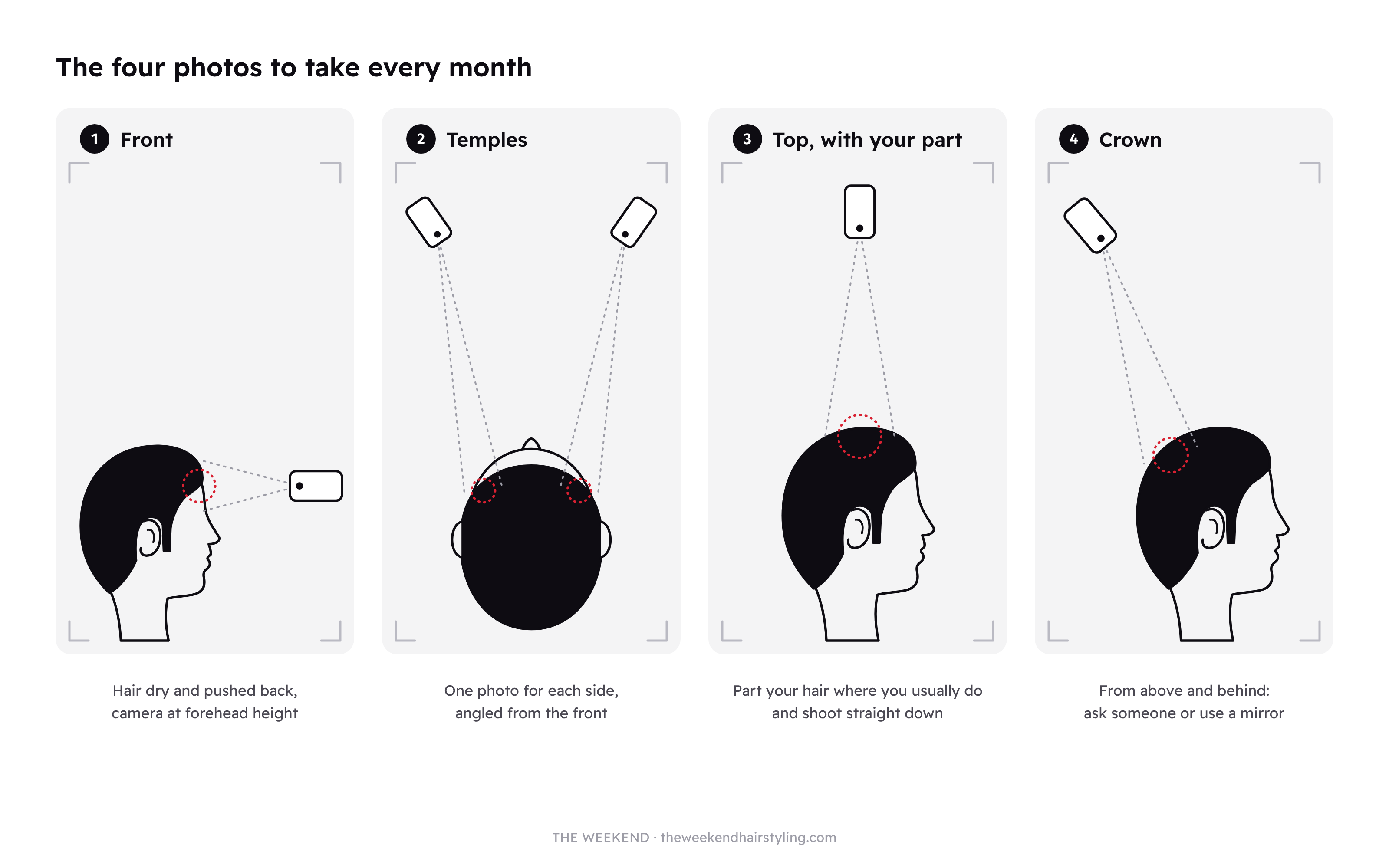
- Front: push your dry hair back so the whole hairline shows, and hold the phone at forehead level.
- Temples: one photo for each side, at an angle from the front, so the corner of the forehead at the temple shows.
- Top with your part: part your hair where you usually do, and shoot from directly above.
- Crown: photograph the top of your head from behind and above. Ask someone to take it, or use a second mirror or your phone's timer.
Practical tip: save the photos in one album named by month, so you can easily put this month's photo next to last month's and the first month's.
Photo rules: how to make the comparison fair
What most often misleads in hair photos is a change in conditions, not a change in hair. Strong light from above, like a lift or bathroom light, and wet hair both show more scalp than is really there. So keep these five rules fixed:
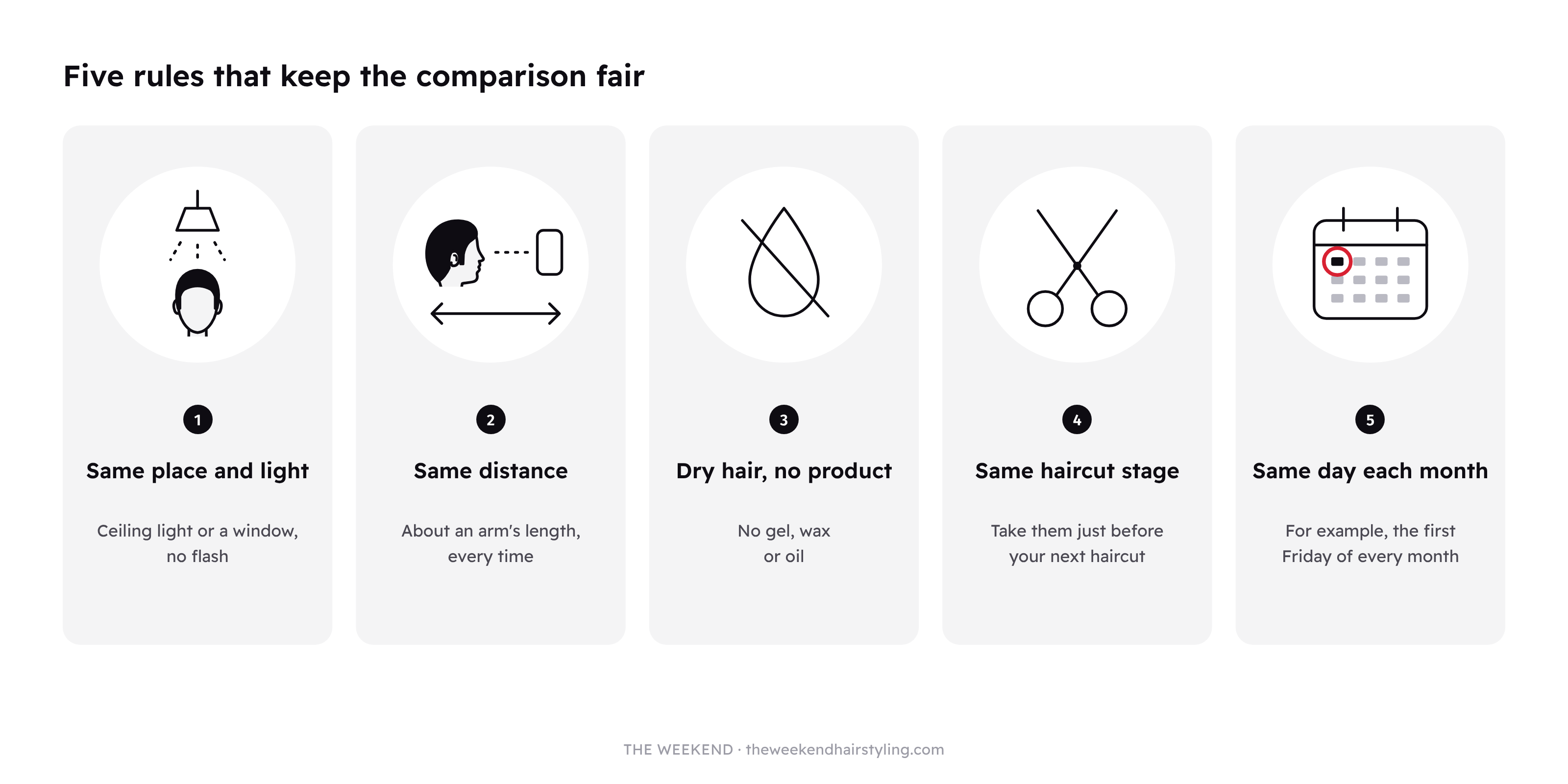
- Same place and light: ceiling light or a window, and no flash.
- Same distance: about arm's length every time.
- Dry hair, no products: no gel, wax or oil, because they clump hair into strands so the scalp shows between them.
- Same haircut stage: take the photos just before your haircut appointment, because hair straight after a cut looks shorter and more scalp shows.
- Same day each month: for example, the first Friday of every month, so you don't forget and the gap between photos stays the same.
What to compare from month to month
Open this month's photo next to last month's, then next to the first month's. Don't look for individual hairs; look for these four things:
| Area | Which photo? | What to look for | More detail |
|---|---|---|---|
| Part width | Top with your part | Is the scalp showing over a wider strip around the part line? | Male pattern baldness |
| Temples | Temples | Have the corners of the forehead deepened, with the line starting to form an M shape? | Receding hairline |
| Hairline | Front | Has the line moved up from the forehead? Are the hairs at the edge finer than the rest of your hair? | Same article (receding hairline) |
| Crown | Crown | Is the lighter area at the top of the back of your head getting wider from photo to photo? | Crown thinning |
Part width
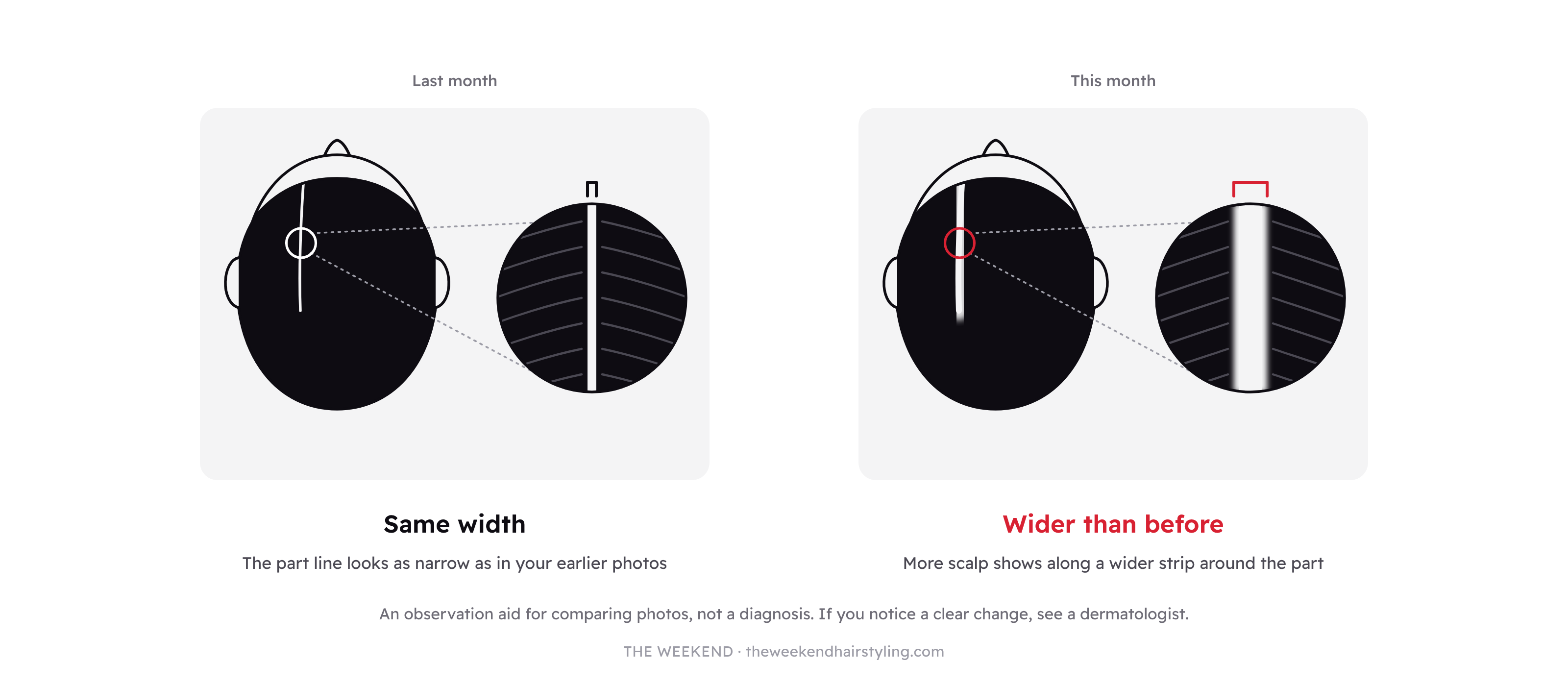
The part is the easiest place to judge density by eye, because it's a clear line. If the part line is as narrow as in your earlier photos, that's reassuring. If the scalp is showing over a wider strip around it, mark it in the tracker and check again next month.
Temples and hairline
Signs of male pattern baldness usually start with hair receding at the temples or thinning at the crown, then progress slowly over years. Not every rise in the hairline is baldness: the hairline may move up a little as it matures in the late teens or early twenties, then stay put. The difference between the two, and how to hide the temples with your haircut, is in Receding Hairline in Men.
Crown
You can't see the crown in the mirror, which is why many men notice thinning there late. Watch the cowlick: a natural cowlick stays roughly the same size, while thinning widens from photo to photo. Details in Crown Thinning in Men.
Daily shedding
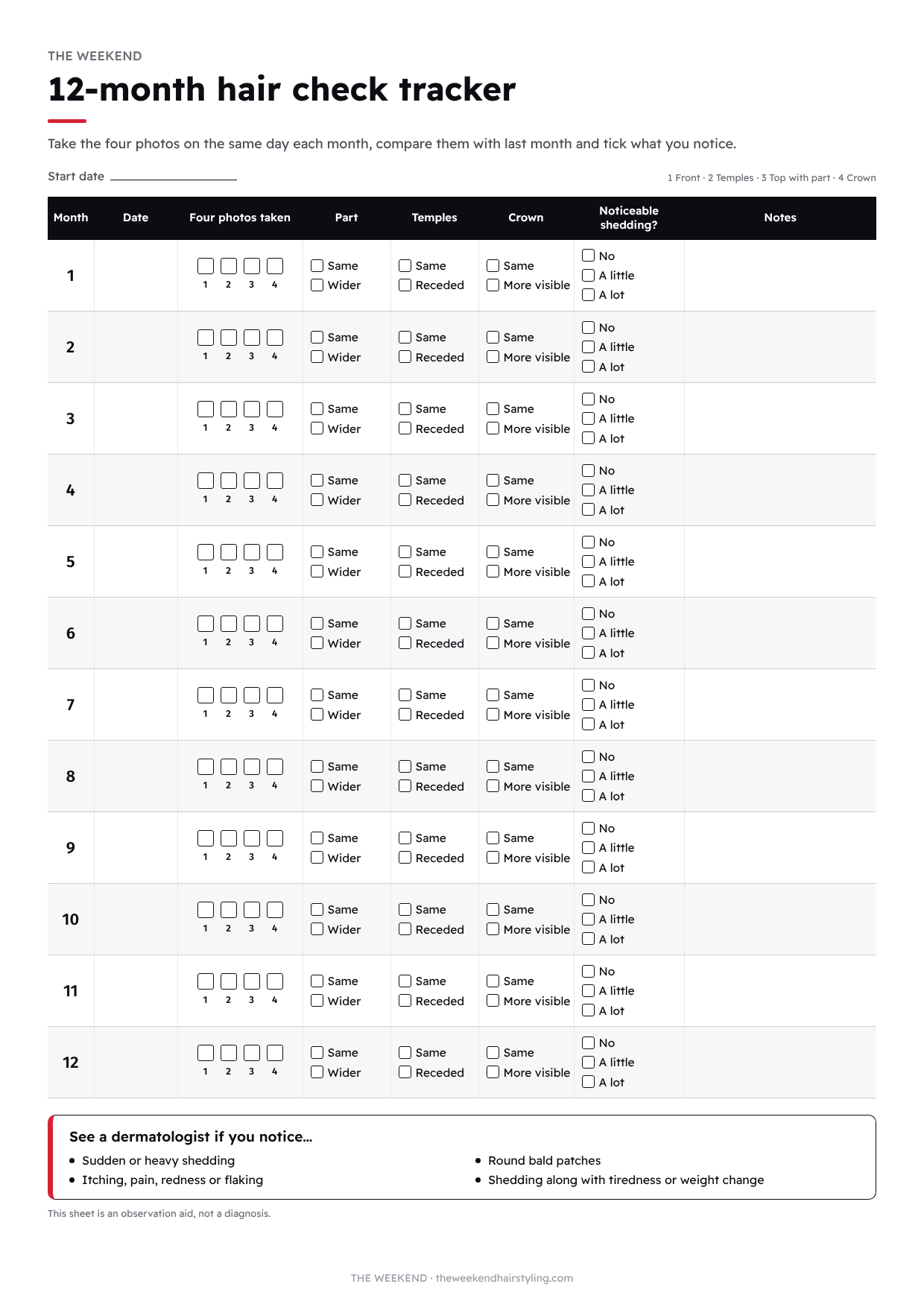
Don't count hairs. Just ask yourself each month: am I seeing more hair than usual when I comb or wash it? The tracker has three boxes for this: No, A little, A lot.
How many months should you track before judging?
The medical sources we relied on don't give a set number of months for tracking at home. But two facts explain why comparing a single month isn't enough:
- Male pattern baldness is slow: it progresses over years, so there may be no visible difference from one month to the next.
- Shedding after stress on the body is delayed: extra shedding after an illness with fever, an operation or severe stress usually shows a few months after the event, and fullness usually returns within 6 to 9 months, according to the American Academy of Dermatology.
So we suggest a practical rule, which is advice from our barbers' experience, not a medical standard: compare each month with the first month and with the photo from three months earlier, not just with last month. If the same change shows up in more than one comparison, that is, in our view, a good time to see a dermatologist and take your photos with you.
And if you see one of the warning signs in the next section, don't wait for the months to pass.
When should you see a dermatologist?
Photos help you notice; the doctor is the one who diagnoses. See a dermatologist if:
- Shedding starts suddenly, or you see more hair than usual, or whole clumps, when you comb or wash it.
- One or more round bald patches appear.
- The shedding comes with itching, pain, burning, redness or scaling on the scalp.
- The shedding comes with ongoing tiredness or a clear change in weight.
- Your hairline recedes with a band of paler skin at the forehead and temples, or the outer ends of your eyebrows thin out.
- The shedding started after a new medicine (don't stop the medicine on your own; ask your doctor).
- Your photos show ongoing thinning that bothers you and you want to know the cause and your options.
Take your photos and the tracker to the clinic: they give the doctor an idea of when and where the change began. The doctor decides on tests and treatment, so don't start any medicine or hair supplements on your own.
12-month hair check tracker (printable)
We designed a tracker for one year: each month you tick off the four photos, then for each area choose "Same" or the change you noticed, mark the shedding, and write your notes. At the bottom there's a reminder of the signs that mean seeing a doctor.
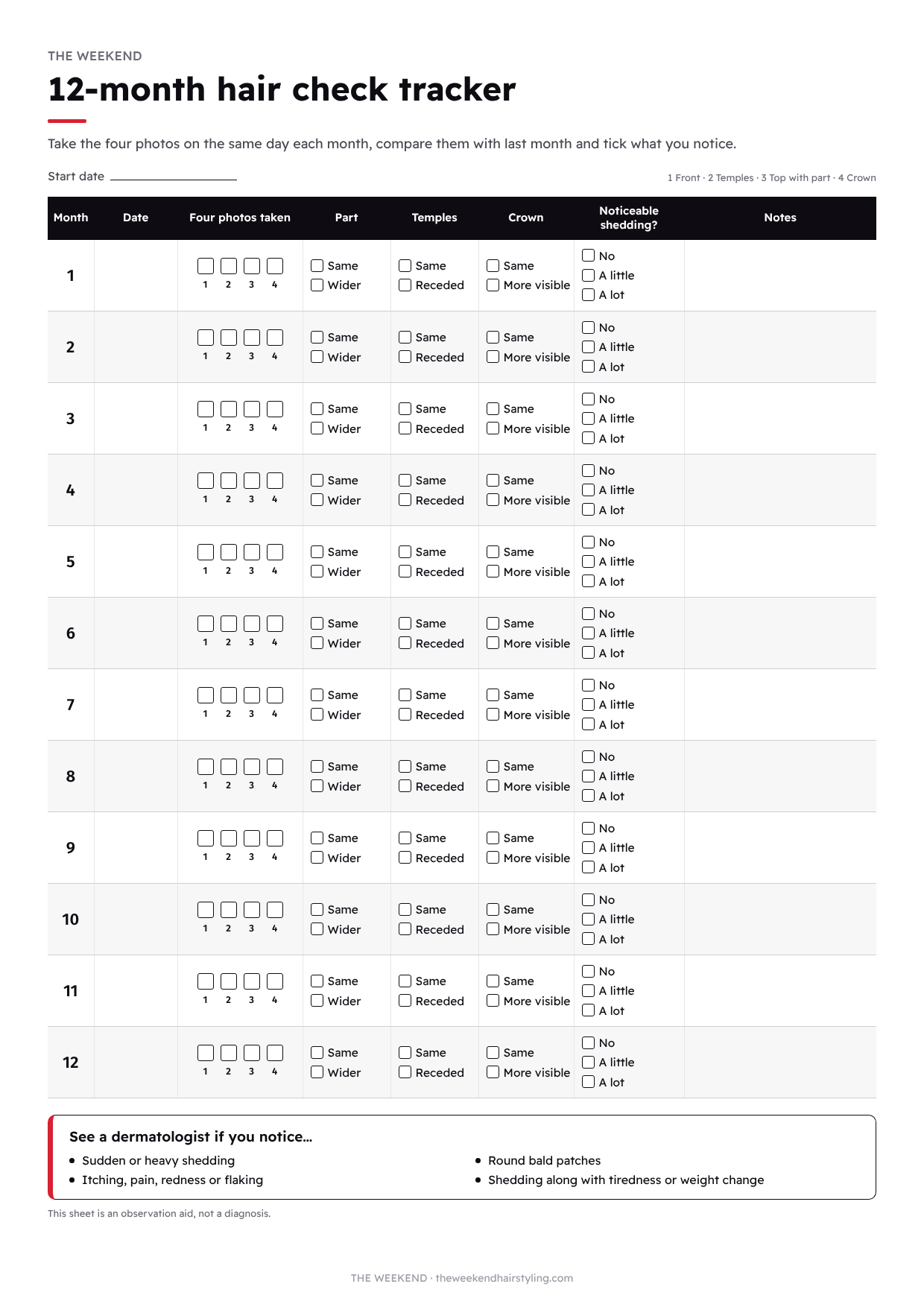
Download the tracker (image to print)
How we made this guide
The photo method and its rules were written by Mahdi, manager of The Weekend's Mursiya branch, from our barbers' daily work looking at hair under different lighting and from angles guests can't see in the mirror. The medical information, such as normal shedding and when to see a doctor, comes from the sources listed below. We drew the graphics and the tracker ourselves, and used no guest photos or data in them. This method is a tool for noticing change, not a diagnosis, and it doesn't replace a doctor's examination.
At The Weekend
Your barber sees the top and crown of your head under good light, from angles you can't see in the mirror. If you have thinning, they'll choose a cut with you that makes it less visible, and can suggest the Batci Hair Concealer Service for SAR 49, which hides gaps and gives a fuller look but doesn't treat hair loss. Haircuts are from SAR 25, depending on the branch, at Al Narjis, ROSHN and Al Rawdah.
FAQ
How do I know if my hair is falling out more than normal?
Losing 50 to 100 hairs a day is normal. Pay attention if you start seeing more hair than usual, or whole clumps, when you comb or wash it, or if the shedding starts suddenly: these are reasons to see a doctor.
What are the early signs of male pattern baldness?
Usually receding at the temples that gives the hairline an M shape, thinning at the crown, or a part that looks wider than before. It progresses slowly over years. We explain its signs and stages in Male Pattern Baldness.
How do I know if my hair is starting to improve?
The same way: photos at the same angles, light and distance, compared with photos from before treatment started. But how long results take to show depends on the cause and the treatment, and the doctor following your case is the one who judges improvement, so take your photos to your follow-up.
Does lighting or wet hair make hair look thinner?
Yes. Strong light from above, like a lift or bathroom light, and wet hair both show more scalp than is really there. So don't judge from a single photo, and always take photos under the same conditions.
Does a home check replace a dermatologist?
No. Photos help you notice and record change, but they can't tell you the cause. Finding the cause and the treatment is a job for a dermatologist's clinic.
Written by Mahdi, branch manager, The Weekend Mursiya, and colour trainer.
Last updated: 21 November 2026.
Sources: Saudi Ministry of Health: Hair loss, Mayo Clinic: Hair loss: Symptoms and causes, American Academy of Dermatology: Do you have hair loss or hair shedding?, Cleveland Clinic: Male pattern baldness (androgenic alopecia), American Academy of Dermatology: Frontal fibrosing alopecia: Signs and symptoms, NHS: Hair loss, Indiana University Department of Dermatology: Noticing a Receding Hairline? What You Can Do About It.