How to Ask a Barber for a Haircut: 7 Decisions + Printable Card
How to ask your barber for exactly the haircut you want: 7 decisions in numbers, from clipper guard and fade type to top length, part, neckline and beard.

How do you ask your barber for exactly the haircut you want? Use numbers, not descriptions: the clipper guard for the sides, the fade type, the top length in centimetres, then the part, neckline, sideburns, line-up and beard. That's seven decisions. Settle them before you sit in the chair and you'll walk out with the haircut you had in mind.
This guide explains each decision in words any barber understands, when a photo helps or misleads, which words cause misunderstandings and what to say instead, and what to say if the cut is going the wrong way. At the end there's "My haircut card" to fill in and show your barber.
Key takeaways:
- Talk in numbers: "Guard 1.5 on the sides and 5 to 6 cm on top" is clearer than "short on the sides and thin it out on top".
- Name the fade type: no fade, taper, low fade, mid fade, high fade or skin fade.
- A photo helps but isn't enough: pick a photo of hair like yours, and say exactly what you like about it.
- Ask for longer first: extra length can be cut afterwards; length that's gone only comes back with time.
- Fill in the card: seven decisions and a note, in one minute before your appointment.
What does your barber need to know before starting?
Most barber misunderstandings come from words, not skill. "Short" to you might mean 1 cm; to someone else it means down to the skin. So we put the decisions on one card in the same order a barber works: sides and back first, then the top, then the details.
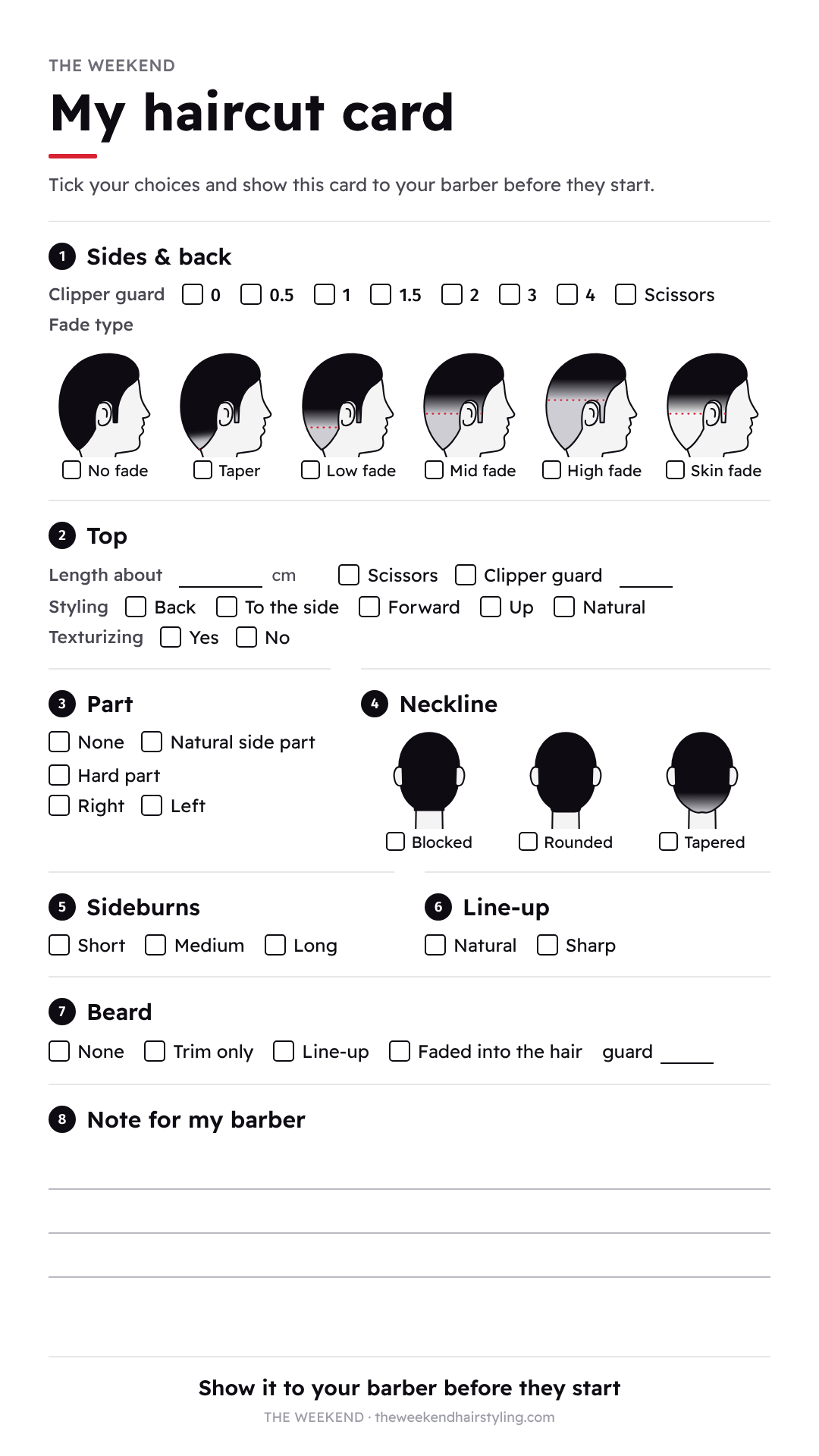
The seven decisions: how to ask your barber for a haircut step by step
1. Sides and back: clipper guard and fade type
Start with the guard number. The card lists 0, 0.5, 1, 1.5, 2, 3 and 4, plus "Scissors" if you don't want clippers on the sides at all. A smaller number means shorter hair, and zero means clippers with no guard.
Then choose the fade type, that is, how the hair moves from short to longer:
- No fade: roughly one length on the sides.
- Taper: light shortening at the sideburns and neckline only; the rest of the sides stays longer.
- Low fade: starts low, just above the ear and neckline.
- Mid fade: starts at about the middle of the side.
- High fade: goes up close to the top of the head, so the sides look very short.
- Skin fade: starts right at the skin, with a razor or clippers at zero.
If you choose a fade, give two numbers: the shortest at the bottom and the number the fade ends at. For example: "Low fade from 0.5 to 2". We explain fade types and how to choose in Fade Haircut Types for Men.
2. Top: length, tool and styling
- Approximate length in centimetres: hold a strand from the top and estimate its length after the cut. Everyone understands "5 to 6 cm".
- Scissors, or clippers and the guard number: scissors give a softer shape that's easier to style; clippers give one even length.
- Styling: back, to the side, forward, up or natural. The styling direction changes how the hair is cut.
- Texturising: yes or no. It removes some bulk and gives hair movement; if your hair is already fine, you may not need it.
3. Part
No part, a natural side part, or a hard part, which is a line cut in with a razor or clippers. And say which side: right or left. That means your head's side, not the mirror's.
4. Neckline
- Blocked: a straight edge with clear corners.
- Rounded: the same edge with rounded corners.
- Tapered: no edge; the hair gradually thins out to the skin. It grows out more naturally than the other two.
5. Sideburns
Short, medium or long. If you have a precise preference, use your ear as a guide, such as "level with the middle of the ear".
6. Line-up
Natural or sharp. A sharp line-up means lines cut with a razor at the forehead, temples and sideburns; it looks very clean for the first few days, then the growth shows quickly. A natural line-up tidies the edges without changing their shape.
7. Beard
None, trim only, line-up, or faded into the hair. If you want the beard shortened with clippers, write the guard number on the card.
At the bottom of the card there's a "Note for my barber" line for anything the options don't cover: the taqiyah or shmagh you usually wear, a cowlick, or an upcoming occasion.
Example: a filled-in card for a classic short cut
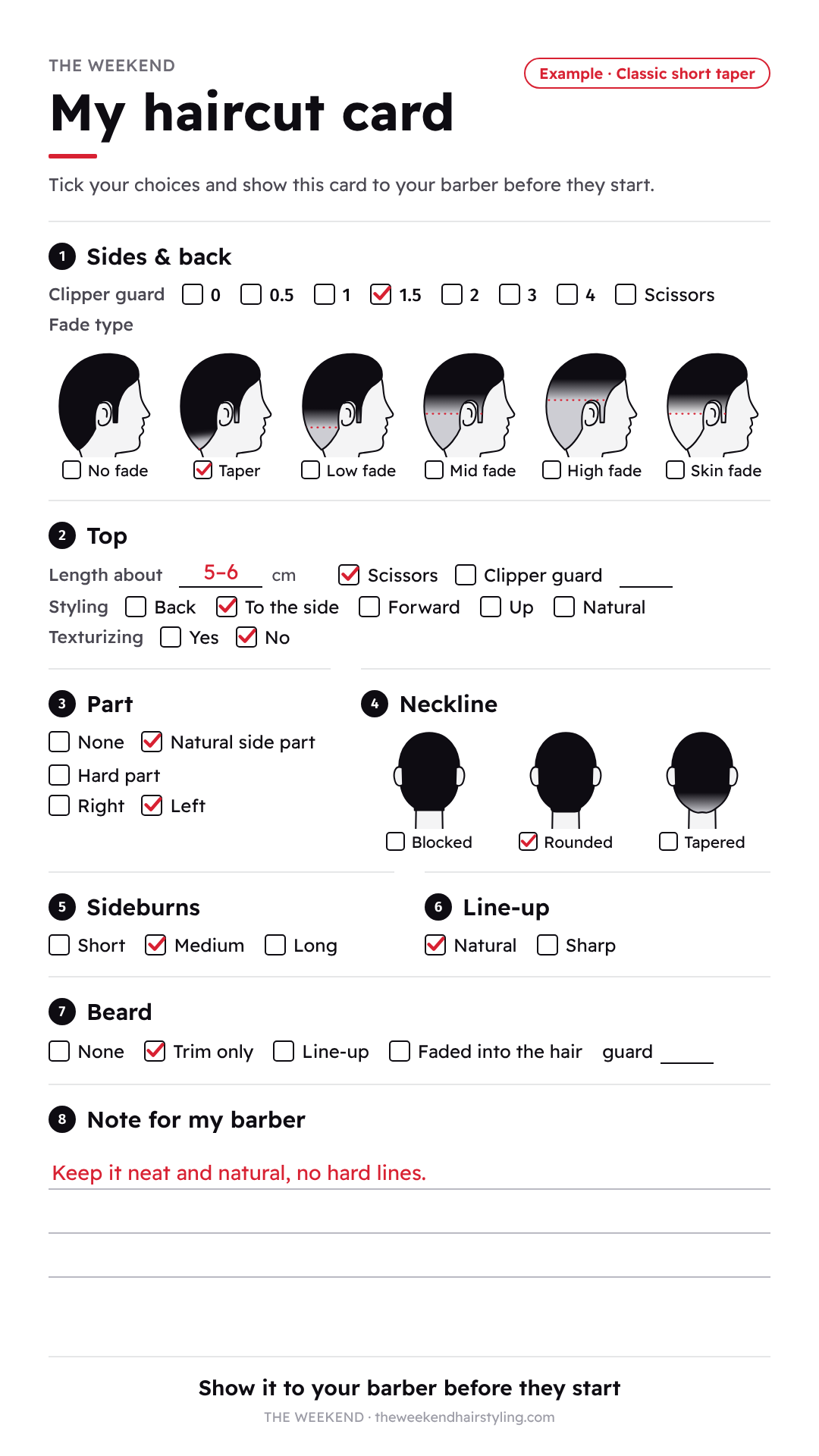
Said out loud, this card would be: "Guard 1.5 on the sides with a taper, 5 to 6 cm on top with scissors, no texturising, styled to the side, a natural side part on the left, rounded neckline, medium sideburns, natural line-up, and just a beard trim." For more examples of classic and other cuts, see our Men's Haircuts Guide.
Clipper guard numbers in millimetres
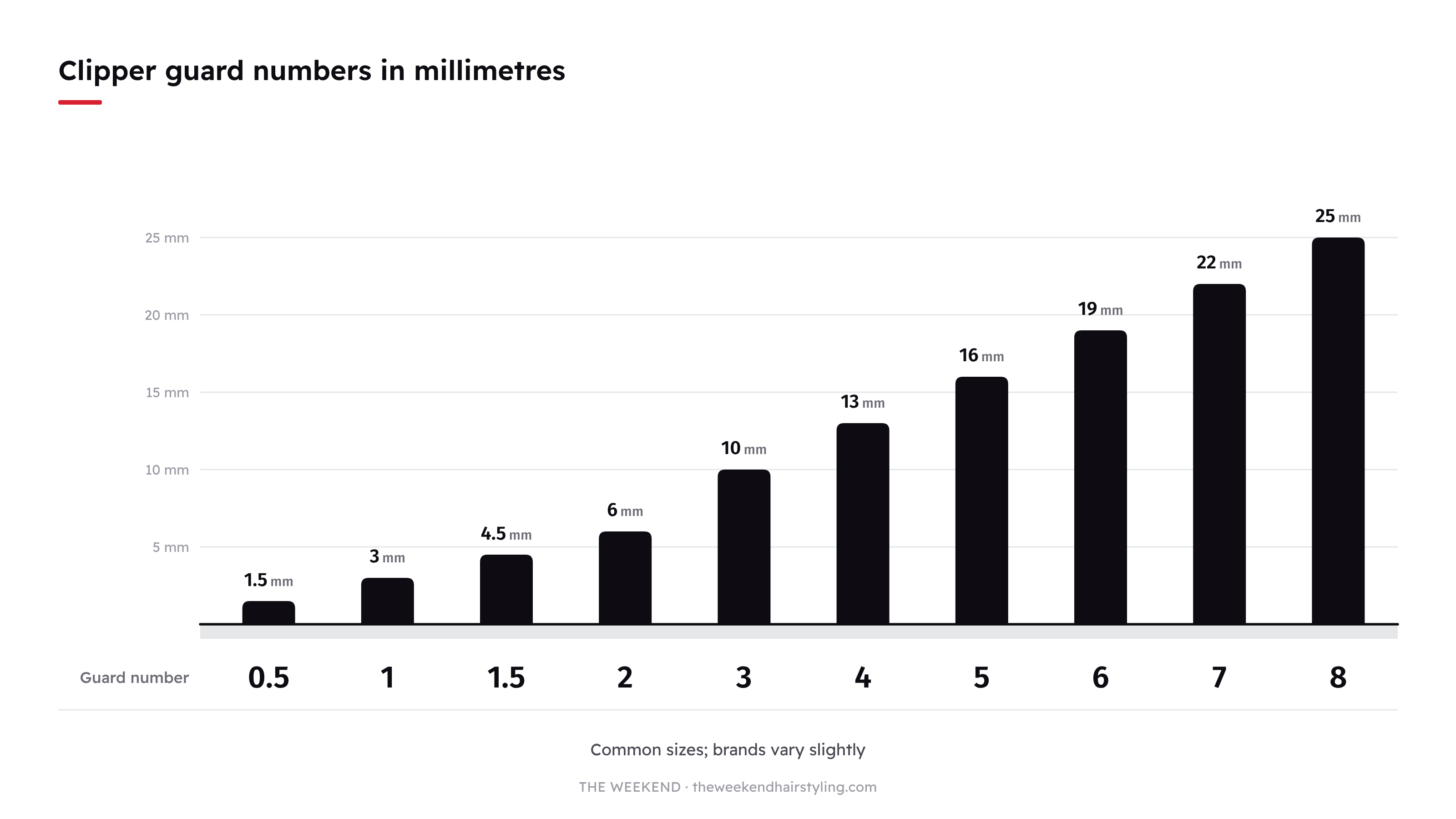
The lengths for numbers 1 to 8 come from Wahl's published guard chart; 0.5 and 1.5 are common values. Lengths can vary slightly between brands, so treat them as approximate.
| Guard number | Approximate length | What it looks like |
|---|---|---|
| 0 (no guard) | Varies by clipper | The closest clippers can get to the skin |
| 0.5 | 1.5 mm | Skin clearly visible |
| 1 | 3 mm | Very short, a little skin shows |
| 1.5 | 4.5 mm | Short and neat |
| 2 | 6 mm | Short, skin usually doesn't show |
| 3 | 10 mm | Conservative short |
| 4 | 13 mm | About 1.25 cm |
| 5 | 16 mm | Hair starts to take a direction |
| 6 | 19 mm | Nearly 2 cm |
| 7 | 22 mm | Short-to-medium length |
| 8 | 25 mm | About 2.5 cm |
If you're unsure between two numbers, ask for the longer one. The difference between 1 and 2 looks small on paper, but it's roughly double the length.
Should you show your barber a photo? When it helps and when it misleads
A photo saves a lot of talking, especially about overall shape and styling. But it has limits:
- Hair type changes the result: the cut in the photo may be on thick, curly or straight hair unlike yours, so it won't give you the same shape.
- The photo is usually carefully styled: product, lighting and a chosen angle. At home you'll be styling it yourself.
- A photo doesn't show the numbers: you can't tell the guard number or fade height precisely, so the barber will estimate them.
Best: two or three photos of the same cut from different angles, on hair close to yours, plus a sentence saying exactly what you like, such as "I like the fade height here, but I want my top shorter."
Words that cause misunderstandings, and what to say instead
| Instead of | Say |
|---|---|
| "Just lighten it a bit" | "Take 1 cm off the top" or "Thin it out without shortening" |
| "Short on the sides" | "Guard 1 on the sides" |
| "Clean up the sides" | "Taper at the sideburns and neckline only" |
| "Take the fade up" | "Start the fade higher" or "Use a longer guard" |
| "Same as last time" | The same numbers, or a photo of your cut after your last visit |
| "Make it neat" | "Natural line-up and a rounded neckline" |
"Just lighten it a bit" in particular can mean cutting length, thinning out bulk, or both. The results are very different, so say which you mean and how much.
Common mistakes when asking for a haircut
- Naming the fade without a number: "low fade" alone doesn't say whether it starts at the skin or at a number 1.
- Mixing up your right and the mirror's right: point to the side by touching your head.
- Forgetting the taqiyah and shmagh: if you wear them daily, say so, because they affect how the sides and sideburns look underneath.
- Asking for a cut that doesn't fit your routine: a cut that needs a blow-dry and product every morning won't look like the photo if you don't do that.
- Staying silent until the end: the hardest time to adjust is after the cut is finished.
What to say if the cut seems to be going wrong
Speak up early and calmly. Your barber would rather hear it at the start than find out you're unhappy at the end.
- After the first clipper pass on the sides: this is your moment. If it looks shorter than you expected, say: "Hold on a second, I want the sides longer than this. Carry on with a longer guard."
- Before the top is cut: say: "Before you cut the top, show me how much you'll take." Ask them to hold up a strand and show you the length.
- If the fade is going higher than you want: say: "Don't take the fade any higher than this," and show the limit with your hand.
- If the cut is finished and you don't like it: pin down exactly what's wrong, such as "the top is heavy" or "the sideburns are short", because some things can be fixed straight away. If the hair is already shorter than you wanted, the only fix is time; next visit, start with a longer guard.
And if you're trying a new cut, choose a quiet slot that leaves room for a conversation. We've gathered the quietest times at our branches in Best Time to Go to the Barber in Riyadh.
Download "My haircut card"
- Download the card to print (high-resolution image): A5 size; tick your choices with a pen.
- Download the card (image for your phone): save it to your photos and mark it up with your phone's editing tool.
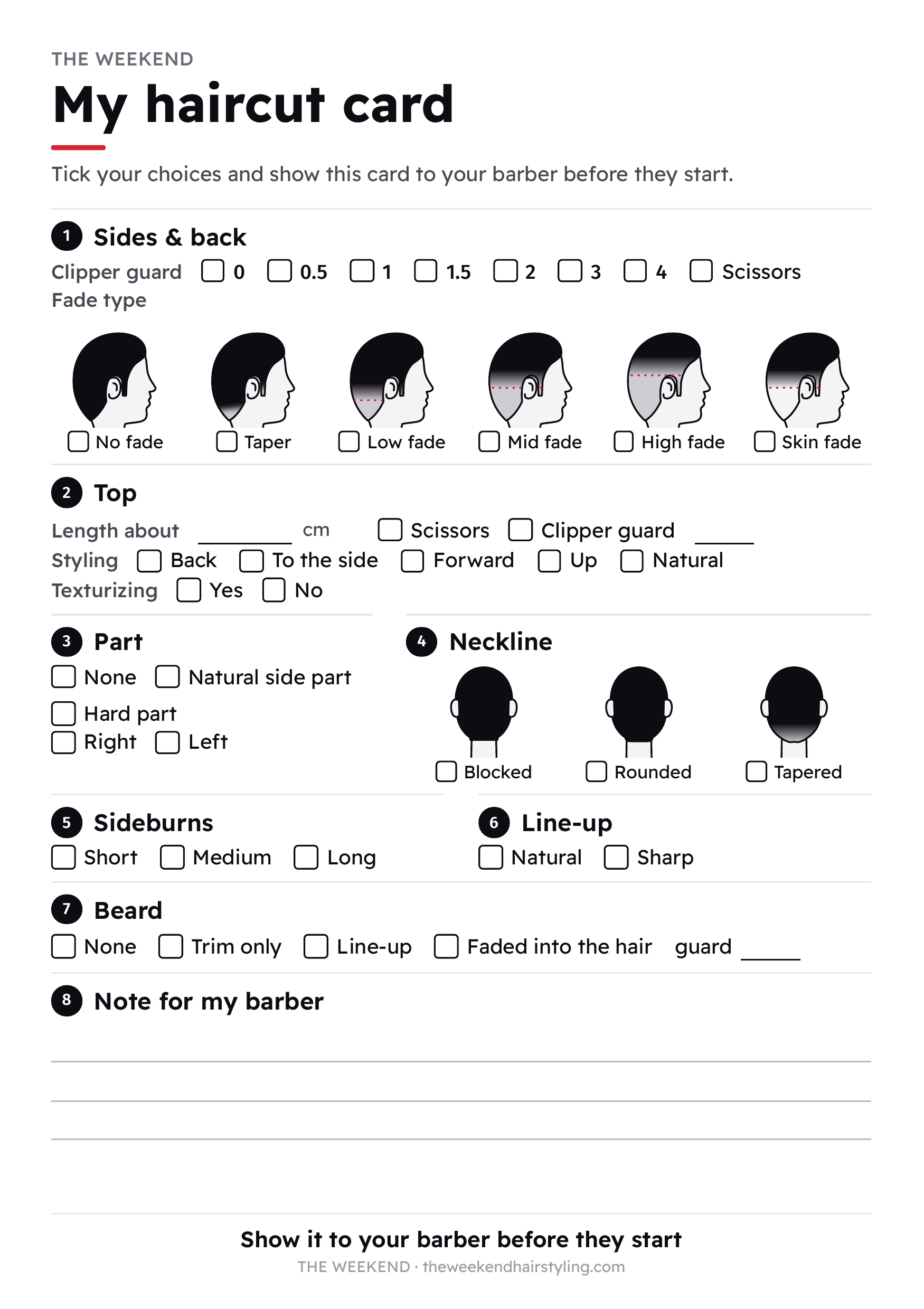
And if a haircut name or term on the card is unclear, you'll find it with its Arabic equivalent in Men's Haircut Names and Barber Terms.
How we made this guide
This guide was written by Bilal, cutting and styling trainer at The Weekend, from day-to-day experience with guests; it is general guidance, not a rule. We designed "My haircut card" and the graphics ourselves, and ordered the card to follow the actual steps of a haircut. We checked the guard lengths for numbers 1 to 8 against Wahl's published chart; 0.5 and 1.5 are the common values, and lengths can vary slightly between brands.
At The Weekend
Show the card to your barber before they start, or save it on your phone and show it when you arrive. Haircuts are from SAR 25 and haircut + beard from SAR 50, depending on the branch, at our Riyadh branches: Al Narjis, ROSHN and Al Rawdah.
Book your appointment · Haircut services
FAQ
How many millimetres is each clipper guard number?
According to Wahl's chart: number 1 is about 3 mm, number 2 about 6 mm, number 3 about 10 mm, number 4 about 13 mm, up to number 8 at about 25 mm. A 0.5 is commonly about 1.5 mm, and lengths can vary slightly by brand.
How do I tell my barber not to cut too much?
Say the length you want to keep, not the length to cut: "I want at least 5 cm left on top" or "Nothing shorter than a number 2 on the sides." And ask to see the length before the top is cut.
What's the difference between a taper and a fade?
A taper shortens the hair at the sideburns and neckline only, so most of the side stays longer. A fade is a gradient that runs across the whole side, starting low, mid or high depending on the type.
Is showing my barber a photo enough?
A photo is a good start, but add the guard number and top length, and choose a photo of hair similar to yours in thickness and type. A photo alone leaves the numbers to guesswork.
How do I get the same haircut every time?
Keep your filled-in card, or photograph your cut from the front, side and back after your visit, and ask your barber which numbers they used and write them on the card.
Written by Bilal, branch manager, The Weekend ROSHN Zone C, and cutting & styling trainer.
Last updated: 21 November 2026.
Sources: Wahl: barber clipper guard numbers and lengths, Wahl UK: clipper cutting lengths with and without guards.